MILWAUKEE WI, USA,
September 24, 2026


Warehouse painting isn't mere cosmetic maintenance; it is operational engineering and vital asset preservation. Yet, sourcing qualified warehouse painting contractors Milwaukee facility managers can depend on often feels like balancing necessary infrastructure repairs against the threat of costly operational delays. If you've ever dealt with flaking high-bay ceilings, peeling floor epoxies, or moisture damage driven by Southeastern Wisconsin's harsh freeze-thaw cycles, you know that inadequate surface prep and uncoordinated crews can derail an entire facility schedule.
You shouldn't have to compromise daily productivity just to maintain a secure, compliant building. Discover how professional industrial coating specialists protect your physical assets, maintain regulatory safety compliance, and minimize operational downtime across Greater Milwaukee. In this guide, you'll find clear vetting criteria for hiring fully insured commercial contractors, durable coating systems engineered to withstand heavy forklift traffic, and practical phased execution strategies that keep your logistics lines moving forward.
• Learn how to evaluate proposals from warehouse painting contractors Milwaukee facility managers trust, focusing on clear dry-film thickness specifications and surface prep standards.
• Discover how targeted coating systems, including high-reflectivity ceiling finishes, cut energy consumption while providing durable protection against heavy forklift traffic.
• Understand the critical prep steps needed to protect structural steel and masonry against Southeastern Wisconsin's humidity swings and freeze-thaw cycles.
• Explore phased staging and containment methods that let commercial crews coat active zones without interrupting ongoing shipping and material handling schedules.
• Identify essential substrate repair and patching priorities that prevent premature peeling and extend the working lifespan of your industrial property.
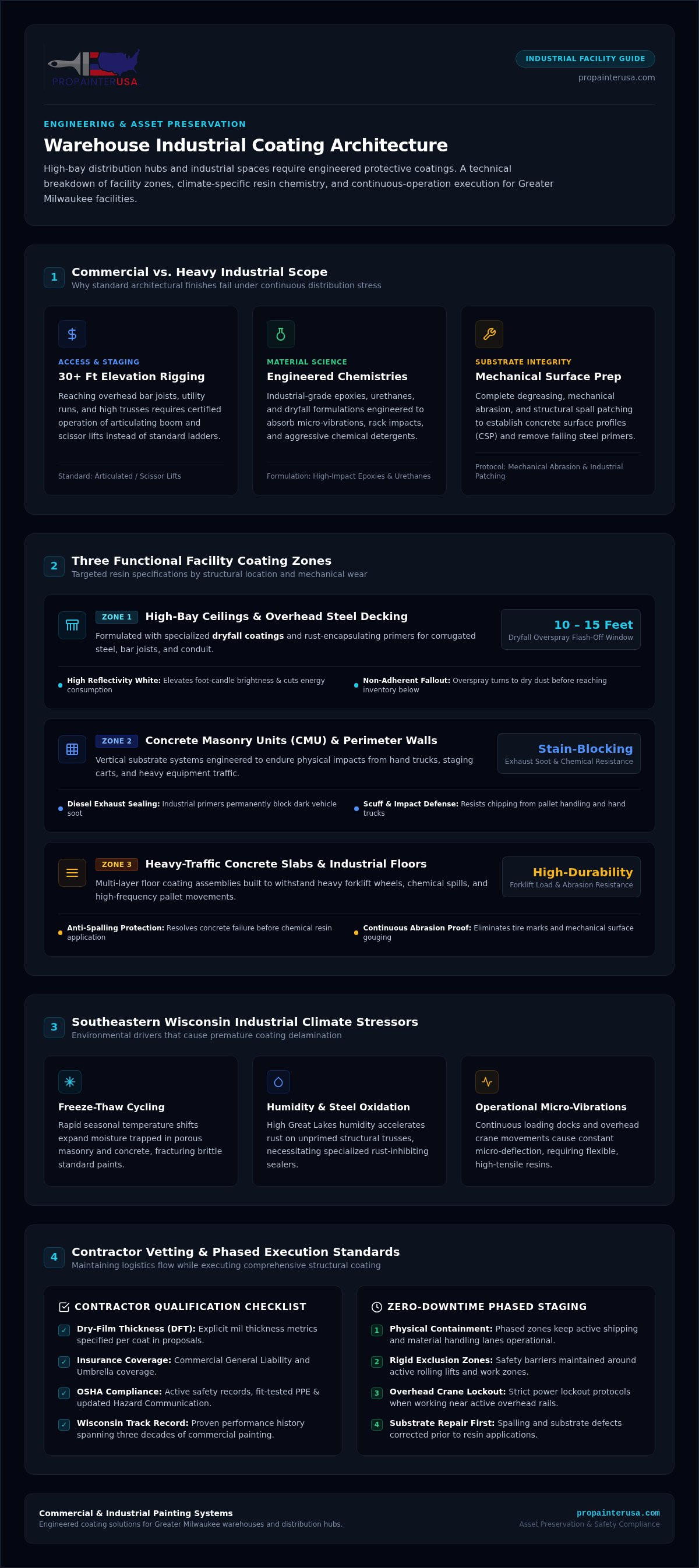
Commercial warehouse painting is never just a cosmetic upgrade. In demanding industrial facilities, structural finishes serve as an engineered defense layer. High-value steel beams, concrete substrates, and tilt-up panels face constant mechanical abrasion, ambient vibrations, and chemical exposure. Applying durable functional coatings shields these vital surfaces from premature breakdown, ensuring the underlying architecture remains sound for decades. Evaluating warehouse painting contractors Milwaukee managers rely on requires understanding how industrial scope diverges from ordinary property maintenance.
While standard retail or office painting prioritizes basic color uniformity and quick visual turnaround, high-bay distribution centers demand rigorous planning. Industrial facilities need comprehensive commercial interior painting and exterior painting, paired with systematic substrate patching to resolve spalling concrete or failing steel primers before any finish coat touches the wall.
Warehouses endure unique operational stress. Continuous forklift traffic scuffs wall corners, pallet racks rattle against framing, and material handling creates constant micro-vibrations that can shatter brittle coatings. Standard architectural paints simply crack and flake under this strain.
Reaching 30-plus-foot joists and overhead trusses demands certified operation of articulating boom lifts and scissor lifts rather than lightweight stepladders.
Industrial spaces require industrial-grade epoxies and urethanes specifically formulated to resist heavy impact and harsh cleansers.
Mechanical abrasion, thorough degreasing, and industrial patching must occur before application to guarantee lasting adhesion.
Safety credentials protect your balance sheet as much as your physical property. When vetting warehouse painting contractors Milwaukee industrial operators should verify active safety records alongside substantial commercial general liability and umbrella coverage. Industrial painters must adhere strictly to modern OSHA compliance, including individualized personal protective equipment fit standards and updated hazard communication programs.
Navigating active logistical lanes brings inherent risk. Seasoned crews implement rigid staging plans, maintaining safe exclusion zones around rolling lifts and locking out power when coating near overhead crane rails. Partnering with a proven local contractor with three decades of Wisconsin commercial painting experience ensures your facility stays protected, compliant, and structurally sound without needless risk.
Industrial facilities cannot rely on standard paints engineered for ordinary drywall. Active distribution hubs experience mechanical vibration, chemical exposure, and constant impact. Experienced warehouse painting contractors Milwaukee operators hire divide facility interiors into three distinct functional zones: overhead structural decking, vertical masonry walls, and traffic-heavy concrete slabs. Selecting the right resin chemistry for each plane prevents premature failure while maximizing operational safety.
Coating overhead bar joists, utility conduits, and corrugated steel decking requires specialized dryfall formulations. These paints dry to a non-adherent dust within ten to fifteen feet of falling, preventing overspray damage to sensitive inventory or machinery below. Applying rust-encapsulating primers seals aging steel framing against oxidation, while high-reflectance white finishes bounce illumination down into the work zones. This strategic brightness gain elevates foot-candle levels and lowers facility energy consumption.
Perimeter walls constructed from concrete masonry units (CMU) face regular abuse from staging carts, hand trucks, and forklift tines. Industrial stain-blocking primers lock out stubborn diesel exhaust soot and moisture before topcoats are applied. For facilities needing long-term resilience, combining thorough substrate patching with specialized commercial interior painting provides a seamless, high-build finish. These scrubbable industrial coatings resist daily abrasion and easily withstand repeated pressure washing.
A dependable floor coating depends on rigorous mechanical diamond grinding rather than weak acid etching. Grinding opens the concrete pores, creating an ideal profile that bonds 100% solids epoxy basecoats to the slab under punishing forklift weight. Capping that base with an abrasion-resistant aliphatic urethane topcoat creates a dense shield against heavy tire scuffing and chemical spills.
Safety striping completes the floor system. High-visibility yellow, safety red, and contrasting cross-hatching define pedestrian walkways, staging zones, and forklift rights-of-way. Aligning facility layout and chemical storage identification with OSHA's Hazard Communication Standard protects workers and ensures your distribution center passes regulatory inspections without unexpected delays.
Operating an industrial building near Lake Michigan presents environmental challenges that generic maintenance guidelines simply overlook. Southeastern Wisconsin experiences extreme thermal swings, swinging from sub-zero winter freezes to humid summer heat waves. These shifts force masonry and metal expansion joints through continuous movement cycles. Moisture penetrates untreated joints, freezes, and fractures surrounding concrete. Knowledgeable warehouse painting contractors Milwaukee facility teams hire monitor atmospheric readings daily, ensuring seasonal climate swings don't compromise coating adhesion.
Lake-effect humidity swings frequently chill heavy structural steel below the ambient indoor temperature, causing invisible condensation. Applying paint over invisible moisture leads to instant blistering and catastrophic delamination. Industrial coatings require the surface temperature to remain at least 5 degrees Fahrenheit above the dew point throughout both application and curing phases.
Unheated logistics terminals also struggle with sweating slab syndrome, where cold concrete floors condense moisture out of warm incoming air. Experienced industrial teams test concrete moisture vapor transmission rates and adhere strictly to established SSPC surface preparation standards to verify substrates are dry, properly profiled, and thermally ready for resin application.
Loading dock aprons face relentless punishment. Delivery semis drag corrosive road salt and de-icing chemicals directly against overhead bay doors, structural jambs, and exterior metal siding. Combined with severe wind exposure off the lake, unsealed joints corrode quickly.
Specialized rust inhibitors isolate steel framing and stop chemical salt corrosion at the door frame.
Flexible exterior coatings expand and contract during sharp seasonal temperature drops without cracking.
Targeted painting of metal rollup panels prevents continuous weathering from spreading to internal lifting mechanisms.
Managing these harsh environmental factors requires field experience with regional architecture, similar to the approaches outlined for commercial painting contractors in Wauwatosa: commercial painting contractors in Wauwatosa. Factoring local weather variables into your commercial exterior painting schedule keeps industrial assets secure against the elements year after year.
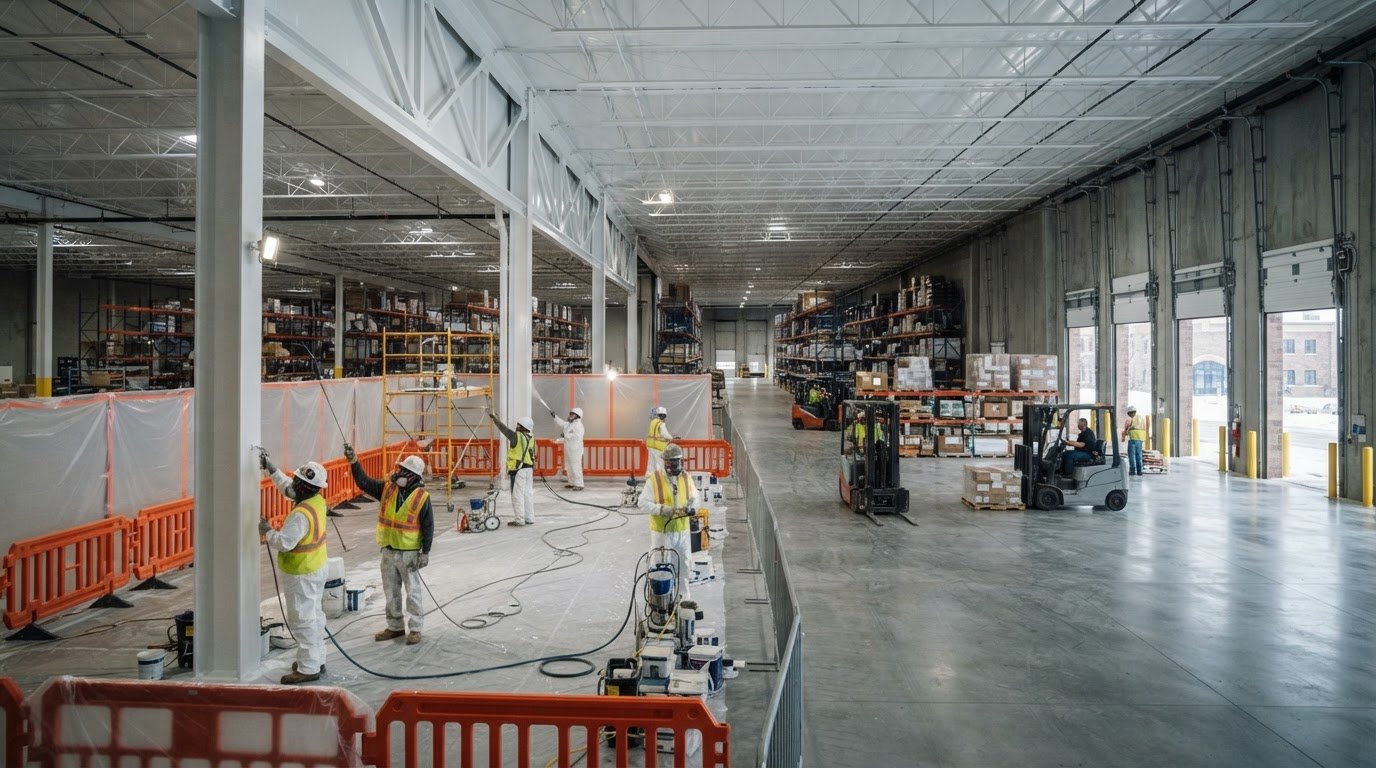
Shutting down a distribution terminal for building maintenance is rarely an option. Logistics managers face strict delivery windows, tight shipping schedules, and continuous material transport. Capable warehouse painting contractors Milwaukee facilities trust don't expect operations to pause. Instead, they treat project scheduling as a precise logistical coordination, isolating work zones systematically so your daily warehouse workflow continues uninterrupted.
Successful execution relies on dividing expansive square footage into manageable quadrants. Rather than staging an entire facility at once, crews isolate specific aisles or loading bays in coordinated sequences. Work progresses through designated sections, allowing fork trucks and order pickers to detour into adjacent, fully functional bays without safety hazards.
Establishing temporary perimeter zones keeps lift machinery safely separated from daily warehouse traffic.
Coordinating work during off-shifts, lower-volume operational hours, or planned weekend windows maximizes crew speed.
Staging routes are mapped alongside floor managers beforehand to avoid blocking active inventory racks.
Protecting raw materials, finished stock, and sensitive packaging from airborne dust is critical. Commercial crews erect heavy-duty, floor-to-ceiling poly containment barriers to seal active paint zones from adjacent logistics lines. In addition, portable HEPA air scrubbers maintain negative pressure, capturing concrete dust and blast particulate right at the source during mechanical surface preparation.
Air quality matters just as much as physical containment. Modern waterborne epoxies and low-VOC industrial formulas eliminate strong solvent odors, preventing noxious chemical migration into neighboring offices or food packaging storage. Keeping employees safe and operations active requires disciplined job site controls. If your building needs durable updates without logistics disruption, contact Pro Painter USA for a commercial facility consultation to plan your phased maintenance strategy.
Facility managers can easily get swayed by bottom-line totals when reviewing contractor bids. However, evaluating warehouse painting contractors Milwaukee businesses trust requires looking beyond a single lump sum. A suspiciously low bid often signals skimping on critical substrate prep, applying thinner dry films, or bypassing essential safety protocols. True asset protection demands a transparent, itemized proposal that defines measurable performance benchmarks before work begins.
A comprehensive industrial proposal removes guesswork from the contracting process. Professional documentation should outline exact mechanical prep methods, specify target dry-film thickness (DFT), and guarantee that coatings bond securely to the structural framing.
Bids must explicitly state whether concrete requires mechanical grinding and confirm that steel framing will be degreased and hand-tool cleaned.
Make sure the proposal identifies the precise manufacturer and product lines rather than generic trade labels.
Structural spalls, hairline fractures, and unsealed masonry joints should be itemized for repair prior to coating application.
Evaluating commercial line items follows clear budgeting principles, similar to the scope breakdowns examined in our guide on house painting estimates in Milwaukee. Thorough quotes protect facility directors from surprise change orders midway through execution.
Long-term coating performance ultimately depends on contractor reliability. Locally owned and operated out of Wauwatosa, Pro Painter USA brings approximately 30 years of hands-on painting experience to facilities throughout Greater Milwaukee, including Oak Creek and Menomonee Falls. We understand how regional weather extremes stress industrial buildings, and we engineer our commercial interior painting, exterior painting, and substrate patching to withstand that constant strain.
Our team provides dependable, accountable project oversight from initial high-bay evaluation to final quality walk-through. Ready to protect your building infrastructure while keeping logistics lines moving? Connect directly with the Pro Painter USA commercial team to schedule an in-person site walk-through and customized facility assessment.
Preserving the structural integrity of your distribution hub requires more than a standard coat of paint. Long-term performance demands rigorous mechanical prep, specialized coatings engineered for regional humidity swings, and coordinated sectional phasing that keeps your material handling lines moving. When evaluating warehouse painting contractors Milwaukee facility directors can depend on, proven technical discipline and dependable on-site oversight make all the difference.
Locally owned and operated out of Wauwatosa, Pro Painter USA brings approximately 30 years of professional industry experience to commercial interior painting, exterior protection, and structural patching across Wisconsin. Our team treats your building as a vital business investment, ensuring every surface is prepped and finished to resist mechanical abrasion and harsh climate cycles. Request a commercial facility walk-through with Pro Painter USA today to protect your high-value assets and keep your logistics operations running smoothly.
Yes, professional industrial painting projects are routinely completed in active facilities without halting normal daily operations. Crews implement sectional grid containment, isolating designated aisles with heavy-duty poly barriers to contain dust and overspray. This modular staging preserves continuous material movement through adjacent lanes, while flexible scheduling during second or third shifts allows work to advance without logistics conflict.
Dryfall paint is a specialized coating engineered so that overspray droplets dry into inert, non-sticking dust before settling to the ground. Recommended by warehouse painting contractors Milwaukee facilities trust for heights above fifteen feet, dryfall prevents wet paint mist from adhering to inventory, racking, and staging equipment below. Cleanup requires only simple vacuuming or sweeping of the fallen dry residue.
Most standard industrial epoxy systems require roughly 48 to 72 hours of full cure time before handling continuous forklift traffic. Light foot traffic is often permissible within 24 hours. For facilities with tight logistics windows, fast-curing polyaspartic coatings can achieve complete return-to-service in as little as one day, depending on interior ambient humidity and concrete slab temperatures.
Cold Wisconsin winters don't stop interior painting projects as long as indoor ambient and substrate temperatures stay within chemical specifications. Capable warehouse painting contractors Milwaukee teams hire monitor surface dew points continuously to prevent condensation. Using controlled facility heating and specialized low-temperature curing resin systems allows interior structural coatings and patching work to proceed smoothly throughout January and February.
Thorough preparation requires deep degreasing, mechanical profiling, and repairing structural substrate damage before applying any primers. Structural steel framing demands mechanical scraping and rust encapsulation to remove oxidation. Concrete masonry units and floor slabs require mechanical diamond grinding or power washing to open concrete pores, accompanied by targeted patching to smooth spalls and stabilize cracks for durable adhesion.
Modern low-VOC industrial coatings provide chemical, stain, and abrasion resistance that matches or exceeds older solvent-based options. Advanced waterborne epoxies and urethanes form tight molecular bonds that resist forklift friction, tire scuffing, and industrial cleaning agents. Crucially, they deliver this rugged performance without releasing noxious fumes, protecting indoor air quality for your on-site personnel during application.
High-volume commercial warehouses generally benefit from a comprehensive recoating every five to ten years, depending on traffic density and exposure. Heavily worn surfaces like loading bay door jambs and floor safety striping often require touch-ups every two to three years. Conversely, high-bay reflective ceiling systems and protected exterior wall coatings regularly endure for a decade or more.
You might find these helpful:
We are a team of interior and exterior painters and we are not limited to house painting only. We can paint different businesses like retail shops, commercial buildings, and apartments.
We also provide restaurant painting services. We can give you more information about these services if you give us a call.