

MILWAUKEE WI, USA,
October 5, 2026



A “zero-VOC” label can sound like the clear winner, but it doesn’t tell you everything about a paint’s ingredients, finish, or suitability for your home. Comparing eco-friendly house paint options means looking beyond the front of the can, especially when you want a finish that holds up to everyday use and Wisconsin’s changing seasons.
It’s reasonable to wonder whether lower-emission paint will look as good or last as long as conventional paint. The right choice depends on the surface, the room or exterior, the product’s performance details, and how it’s applied. Colorants can also affect a paint’s VOC content, so “zero-VOC” wording deserves a closer look.
This guide compares low- and zero-VOC paints with mineral- and plant-based alternatives, explains how to read labels, and highlights durability and finish considerations. It also covers how Wisconsin conditions can shape project timing and product selection. Pro Painter USA brings approximately 30 years of painting experience to projects where preparation and the home’s surfaces matter. Use this guide to plan an interior refresh or protect your home’s exterior with greater confidence.
• Assess eco-friendly house paint options by emissions, ingredient transparency, manufacturing impact, and expected lifespan rather than relying on a single label.
• Compare paint types for the specific surface and use, including cleanability, finish choices, and product documentation.
• Use manufacturer information on coverage, washability, sheen, and maintenance to judge performance instead of assuming lower-emission paint will be less durable.
• Plan a Wisconsin paint project in steps: assess the surface, set priorities, review product details, and account for seasonal conditions when scheduling application.
• Build a paint plan around the room or exterior, finish, and maintenance needs. Surface preparation and project planning help support a lasting result.
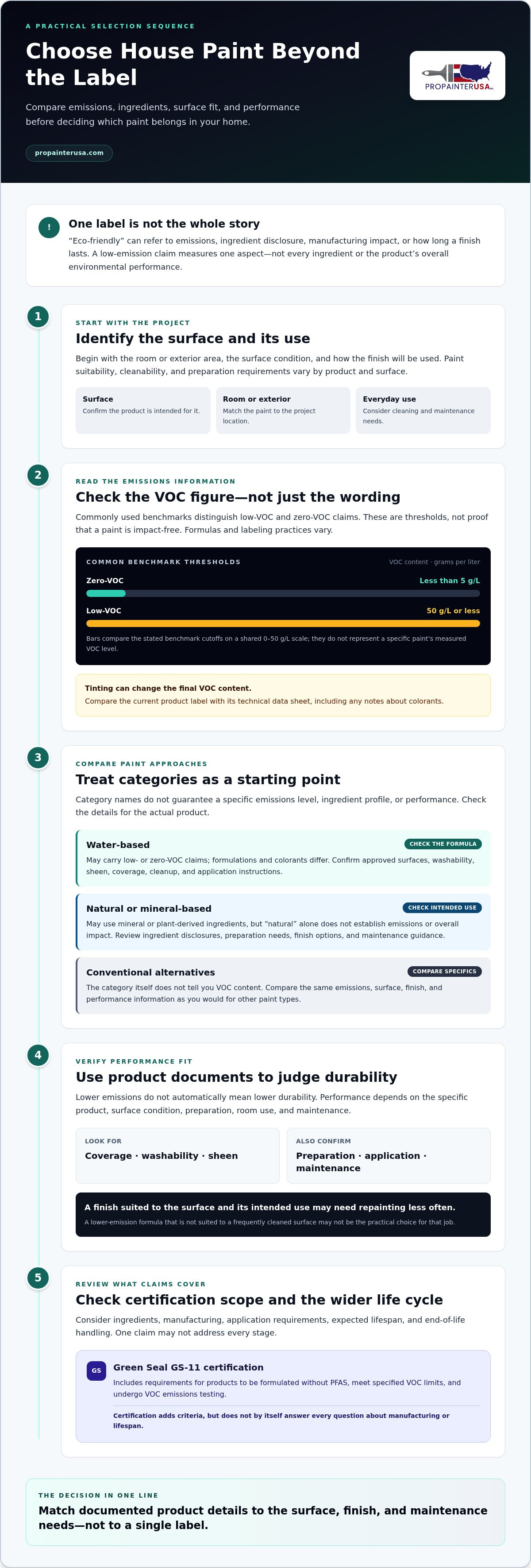
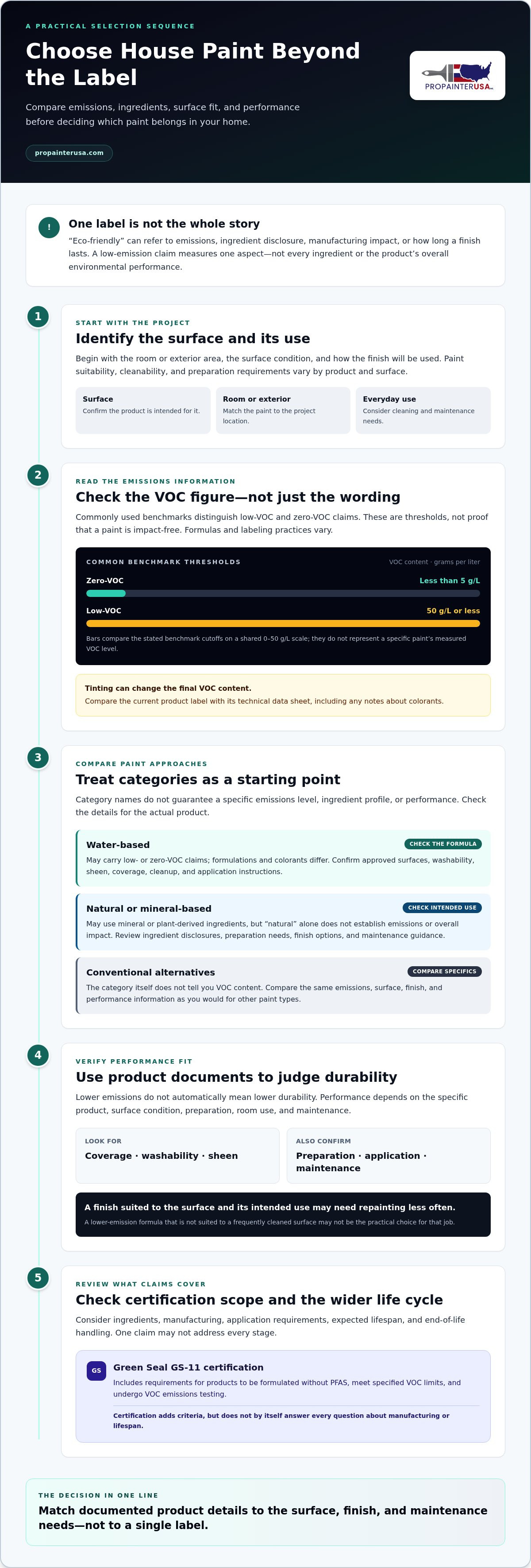
“Eco-friendly” is a broad description, not a guarantee attached to one label. A paint may be designed to release fewer volatile compounds indoors, disclose more about its ingredients, use materials or packaging with lower environmental impacts, or last longer before repainting is needed. These qualities can overlap, but they measure different things. A low-emission claim alone doesn’t establish a product’s overall environmental performance.
Low-VOC claims describe one emissions measure. Overall environmental performance also depends on ingredients, manufacturing, durability, and end-of-life handling. For Milwaukee homeowners, that distinction turns a broad marketing term into practical questions about where the paint will be used and how it needs to perform.
Volatile organic compounds (VOCs) are carbon-containing compounds that can enter the air as gases from some materials, including certain paints. Their types and amounts vary, so a VOC figure describes one aspect of a formulation, not every ingredient or its overall impact.
“Low-VOC” and “zero-VOC” are not interchangeable, and “zero” shouldn’t be read as “impact-free.” Commonly used benchmarks describe low-VOC paint as having 50 grams per liter or less, while zero-VOC paint contains less than 5 grams per liter. Formulas and labeling practices vary, and colorants may affect the final VOC content. Compare the current product label with its technical data sheet, including the VOC figure and any notes about tinting.
Look beyond emissions to consider ingredients, manufacturing, application requirements, how long the finish lasts, and what happens to leftover paint and containers. Product documentation can explain what a manufacturer discloses, but a single claim may not cover every stage.
Durability matters, too. If a finish suits the surface and holds up to its intended use, that area may need repainting less often. The result depends on surface condition, preparation, room use, and maintenance, not just the paint label. A lower-emission formula that isn’t suited to a frequently cleaned surface may not be the most practical choice for that job.
There isn’t one paint category that is automatically the greenest for every home. Compare specific product information against your priorities, whether you want to reduce indoor emissions, understand ingredients, or choose a finish suited to the surface. Good preparation and a project plan tailored to the home also help support a lasting finish.
Paint categories offer a starting point, not a verdict. Water-based, natural or mineral-based, and conventional paints can differ in emissions, ingredients, surface compatibility, and finish. Compare the specific product’s label and technical data sheet to decide which of the eco-friendly house paint options fits your project.
| Paint category | Emissions and ingredients | Surface, cleaning, and finish | What to check |
|---|---|---|---|
| Water-based | May carry low- or zero-VOC claims; formulations and colorants differ. | Suitability, washability, and available sheens depend on the product and surface. | VOC details, approved surfaces, coverage, cleanup, and application instructions. |
| Natural or mineral-based | May use mineral or plant-derived ingredients, but “natural” alone doesn’t establish emissions or overall impact. | Uses and finish characteristics vary; confirm the product is intended for the surface and room. | Ingredient disclosures, surface preparation, finish options, and maintenance guidance. |
| Conventional alternatives | Can include different formulations and emissions levels; the category itself doesn’t tell you the VOC content. | Performance and cleanability depend on the specific paint, sheen, and intended use. | Compare the same documentation and performance details as for other categories. |
These labels describe broad formulation approaches, not guaranteed uses or performance. A water-based paint isn’t automatically right for every surface, and a mineral-based formula may have specific preparation or application requirements. Check the manufacturer’s instructions for the product and project. The EPA’s technical overview of VOCs provides context on VOCs and indoor air, but other environmental attributes need separate review.
Start with the VOC information, intended surfaces, coverage, cleanup method, and available finishes. Then review the technical data sheet for preparation and application details. Certification can add useful criteria, but check its scope: Green Seal’s GS-11, republished in April 2026, includes requirements for products to be formulated without PFAS, meet specified VOC limits, and undergo VOC emissions testing. It doesn’t, by itself, answer every question about manufacturing or lifespan.
Use the same checklist for each candidate, then match the product to the home’s surfaces and maintenance needs. Pro Painter USA can incorporate those priorities into planning for a residential painting project, considering surface condition and preparation alongside the finish.
Lower emissions don’t automatically mean weaker paint, and a conventional formula isn’t automatically more durable. Performance depends on the specific product, surface, preparation, and whether the paint is used as directed. A label describes one attribute, but it can’t predict the finished performance of a project on its own.
For a fair comparison, review the manufacturer’s guidance for coverage, washability, sheen, approved surfaces, and maintenance. These details help you weigh environmental claims against the demands of the room or exterior. The best fit is the product that meets your priorities and suits the job, not simply the one with the most appealing wording on its label.
Match the finish to how the area is used. A surface that gets frequent cleaning may need different washability performance than a low-traffic area. Sheen also affects appearance, so compare available finishes with the look you want and the condition of the surface.
Before choosing among eco-friendly house paint options, consider existing paint, peeling or damaged areas, repairs, and any primer requirements. Check product documentation for coverage and surface compatibility instead of assuming one formula will work across walls, trim, and exterior materials. Patching, preparation, and application matter, too. Even suitable paint may not produce a lasting, even finish if the surface hasn’t been prepared correctly.
Broad phrases such as “green” or “natural” don’t explain what was measured. Look for specific, testable details, such as stated VOC content, disclosed ingredients, or certification with clearly defined criteria. Then compare what that evidence covers with performance information for the intended surface.
A lower-emissions statement doesn’t establish durability, coverage, or the product’s full environmental profile.
A certification may assess selected product attributes, not every ingredient, manufacturing impact, or end-of-life consideration.
Use documented product facts, and don’t infer health or environmental benefits that the evidence doesn’t state.
A careful comparison doesn’t require dismissing useful environmental claims. It means weighing them alongside finish, cleaning needs, surface condition, and expected upkeep. In Milwaukee homes, plan around the specific application instructions and conditions rather than relying on a universal performance ranking.
A thoughtful plan connects a paint’s documented features to the home’s condition and the timing of the work. For Milwaukee-area homeowners, consider both the surface and the season. Exterior paint must be applied under the conditions specified by its manufacturer, while indoor work calls for attention to directions for ventilation and room use.
Use this sequence to organize a project:
Note peeling paint, damage, dirt, and areas that may need patching or priming.
Decide whether emissions, ingredient disclosure, cleanability, appearance, or maintenance matters most for this project.
Review the product label and technical data sheet for surface suitability, preparation, and application requirements.
Consider the forecast for exterior painting and how indoor work will affect room access and use.
Wisconsin’s changing seasons make exterior scheduling an important part of the plan. Temperature, moisture, and surface condition can affect application and the developing finish. Don’t rely on one temperature range as a rule for every paint. Read the selected product’s current instructions for allowable weather and surface conditions, then plan around them.
For interiors, follow the manufacturer’s directions for ventilation, drying, and when the room can return to normal use. Room-by-room planning can also make the project more practical: consider which spaces need to stay accessible and how work in one area may affect daily routines.
Preparation should fit the surface, not follow a one-size-fits-all checklist. A project may call for cleaning, patching, sanding, or priming, depending on existing coatings and surface condition. Sound preparation creates a suitable base for paint and supports a more consistent appearance. Let the product’s instructions guide the preparation steps and application method.
Before work begins, define the areas included, repairs needed, finish preferences, and timing considerations. Pro Painter USA tailors residential painting plans to the home and its surfaces, including preparation and finishing as part of the project. To discuss your home’s painting scope, request a residential painting estimate.
The right paint plan brings together a product’s documented qualities and the needs of the surface. Before deciding among eco-friendly house paint options, clarify what you’re painting, its condition, and what matters most in the finished result. A clear scope makes it easier to compare product information and plan the preparation and application steps.
Start with the project area. Interior walls, trim, doors, and exterior surfaces can have different needs, so identify each surface and note its current condition. Peeling or damaged areas may need repair, while the planned finish and the way the space is used can influence product selection and maintenance expectations.
Then set your priorities. You might focus on emissions information, ingredient transparency, appearance, ease of cleaning, or reducing how often the surface needs attention. Use the product’s label and technical data sheet to compare those details with its stated surface uses and application directions. Keep a short checklist:
What is being painted, and what preparation or repair might it need?
Is it an interior or exterior project, and what appearance and cleanability do you want?
Which emissions or ingredient details matter most to you?
How will the surface be used, cleaned, and maintained?
Project scope and preparation depend on the surfaces involved. A plan for several rooms, for example, may account for different finishes and room uses, while exterior work needs to consider the condition of the specific areas being painted. Avoid choosing by label alone. Connect each product claim to the job it’s meant to do.
A residential painter can use your priorities to guide project planning, including the areas involved, surface condition, preparation, priming, and finishing. Pro Painter USA provides residential interior and exterior painting, along with surface preparation, priming, finishing, patching, and related repairs. With approximately 30 years of industry experience, the team tailors planning to the home and its surfaces rather than relying on a one-size-fits-all approach.
Bring your product research and project priorities into the conversation. Pro Painter USA offers free project estimates online or by phone, a practical next step for discussing the scope of your residential painting project and planning work that suits your home.
Choosing among eco-friendly house paint options starts with more than a label. Compare emissions and product documentation, then weigh coverage, finish, and maintenance against the needs of each surface. For a lasting result, the paint needs to suit the project, and preparation and application matter just as much as product selection.
Pro Painter USA brings approximately 30 years of industry experience to residential interior and exterior painting across Wisconsin. Surface preparation, priming, finishing, and repairs can be included in a plan tailored to your home and its surfaces. That gives you a practical way to carry priorities such as emissions and cleanability into the project scope.
Ready to discuss your home’s painting needs? Request a free painting estimate for your home online or by phone. With a clear plan and attention to the surfaces, you can move forward with confidence and choose a finish suited to your home.
No. A low-VOC claim describes one aspect of a paint’s emissions, not its complete environmental profile. It doesn’t by itself explain ingredient transparency, manufacturing impacts, durability, or disposal. For Milwaukee homeowners comparing eco-friendly house paint options, review the current label and technical data sheet, then weigh the documented emissions information alongside surface suitability, expected maintenance, and other details relevant to the project.
No. “Zero-VOC” doesn’t necessarily mean a paint has no emissions or smell. The term is commonly used for paint containing less than 5 grams per liter of VOCs, and trace amounts may remain. Odor can also come from ingredients other than VOCs. Check the product’s current documentation, follow its ventilation and room-use instructions, and don’t assume low-odor paint needs no precautions.
Some lower-emission paints can perform well, but durability depends on the specific formula, surface, preparation, and application. Compare product documentation for coverage, washability, sheen, approved surfaces, and maintenance guidance rather than assuming all eco-friendly or conventional paints perform alike. In Milwaukee homes, the right choice for an interior wall may differ from one for exterior siding. Proper preparation and following application directions help support a consistent finish.
Low-VOC describes a paint’s volatile organic compound content, while “natural” usually refers to the types or sources of ingredients. These claims aren’t interchangeable: natural paint isn’t automatically low-VOC, and low-VOC paint isn’t necessarily made with natural ingredients. Compare specific ingredient disclosures and VOC information on the product label and technical data sheet. Also check whether the paint suits your intended surface and use.
Yes, if the specific product is intended for the exterior surface you’re painting and its instructions fit the project. Wisconsin’s seasonal weather makes planning important: temperature, moisture, and surface condition can affect application. For a Milwaukee-area home, follow the manufacturer’s current directions for allowable weather and surface conditions instead of relying on a universal temperature rule. Residential exterior painting also requires preparation suited to the home’s surfaces.
Choose a product with emissions information that suits your priorities, then follow its label for ventilation, application, drying, and room use. Where practical, keep the room ventilated as directed and limit access while painting and as the coating dries. Don’t assume “zero-VOC” means odor-free or that ventilation is unnecessary. For a room-by-room project in Milwaukee, plan the work around how your household uses each space.
You may overlook important details, such as whether the paint suits the surface, provides the finish you want, or can handle the room’s cleaning needs. A broad label may also leave questions about ingredients, product documentation, and expected upkeep unanswered. Compare specific claims with the technical data sheet and project requirements. In Milwaukee homes, matching paint and preparation to the surface makes the choice more practical.
You might find these helpful:
We are a team of interior and exterior painters and we are not limited to house painting only. We can paint different businesses like retail shops, commercial buildings, and apartments.
We also provide restaurant painting services. We can give you more information about these services if you give us a call.


